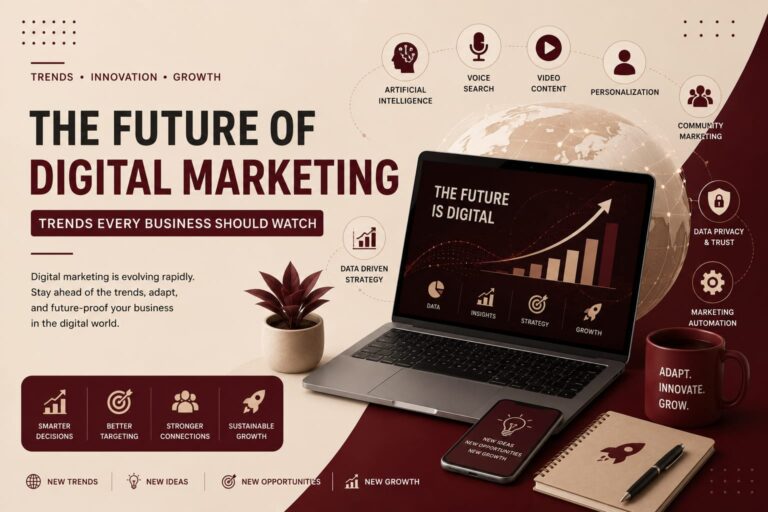
The Future Digital Marketing: Trends every business Should Watch
Digital marketing is moving faster than it has in years. AI tools are maturing, privacy rules are reshaping how data gets collected and used, and the way people discover brands is shifting away from traditional search toward social and community-driven channels. For businesses trying to plan ahead, here are the trends actually shaping strategy right now — and what they mean for how you reach, engage, and convert customers.
1. AI Moves from Automation to Strategy
AI in marketing used to mean scheduling posts and running basic A/B tests. That’s changed. AI now sits at the center of how campaigns are planned and executed — analyzing customer behavior, generating content variations, and adjusting campaigns in real time based on performance data.
This is changing what marketers actually do day to day. Execution is increasingly automated, while the human role shifts toward interpreting data, directing strategy, and deciding which insights to act on. The businesses getting the most value aren’t the ones using the most AI tools — they’re the ones who know how to direct them well.
A related development worth watching: agentic AI. Rather than just assisting with tasks, autonomous systems are starting to make multi-step decisions and execute entire campaign workflows with minimal human input — from budget reallocation to bid adjustments across channels.
2. Personalization Is No Longer Optional
Generic, one-size-fits-all messaging is losing ground fast. Consumers now expect brands to know what they want — and they reward the ones that deliver. Research shows roughly three in four consumers are more likely to buy from a brand that offers personalized content.
For businesses, this means personalization has to run through the entire customer journey, not just email subject lines. That includes personalized product recommendations, dynamic website content, and ad creative that adapts based on browsing behavior — all powered by first-party data.
3. Trust and Authenticity Have Become a Competitive Advantage
As AI-generated content floods every channel, distinguishing real from fake has become harder for consumers — and more important to brands. Trust is emerging as a genuine differentiator, not just a nice-to-have brand value. Businesses that are transparent about how they use AI, protect customer data, and communicate honestly are starting to see that translate into loyalty.
This also connects to a broader shift in how people discover brands. Social content, recommendations, and online communities are increasingly where discovery happens, with traditional search increasingly used afterward — to validate a purchase decision rather than start one.
4. Video Keeps Evolving — and Getting More Shoppable
Video isn’t a new trend, but how people consume and act on it is changing. Connected TV (CTV) and platforms like YouTube are becoming bigger players in advertising as video consumption shifts across screens. At the same time, shoppable video is turning passive viewing into direct purchasing — embedding product links directly into video content so viewers can buy without leaving the platform.
For businesses, this means video strategy needs to think beyond brand awareness and toward conversion — treating high-attention video moments as a sales channel, not just a top-of-funnel tool.
5. Interactive and Immersive Content Is Growing
Static content is giving way to formats that invite participation: interactive quizzes, shoppable posts, AR try-on experiences, and immersive brand experiences that blend digital and physical engagement. This works because it makes people feel more connected to a brand — and it tends to generate better engagement data than passive content.
Augmented and virtual reality, in particular, are helping brands close the gap between digital marketing and real-world experience, giving customers a way to interact with products before buying.
6. Measurement Is Getting More Complex — and More Important
As ad channels and data sources fragment further, businesses can no longer measure performance channel by channel. This is driving renewed investment in cross-channel measurement approaches like Marketing Mix Modeling (MMM), which helps businesses understand how channels work together rather than in isolation — especially as privacy changes limit traditional tracking methods.
Marketers are also increasingly looking to use AI predictive models to forecast campaign performance before launch, rather than relying purely on post-campaign analysis.
What This Means for Your Business
You don’t need to chase every trend at once. A practical starting point:
- Audit your data strategy. Personalization and predictive AI both depend on good first-party data — make sure you’re collecting and using it responsibly.
- Pick one AI use case and get good at it. Whether it’s content generation, campaign optimization, or performance forecasting, depth beats breadth here.
- Invest in trust signals. Clear privacy practices, authentic content, and transparency about AI use are becoming genuine differentiators.
- Rethink video as a sales channel, not just a branding tool.
- Don’t abandon measurement fundamentals just because the landscape is fragmenting — if anything, cross-channel measurement matters more now.
The businesses that win in this environment won’t necessarily be the biggest spenders — they’ll be the ones who adapt their strategy as fast as the landscape is changing.
Type your paragraph here